

If 2020 was a lesson in anything, it was to expect the unexpected. Who could have predicted a year of such unprecedented worldwide disruption?
If 2020 was a lesson in anything, it was to expect the unexpected. Who could have predicted a year of such unprecedented worldwide disruption?

Hello everyone and welcome to 2021!
For the first release of 2021, the CAS 360 team have worked on some great new features.
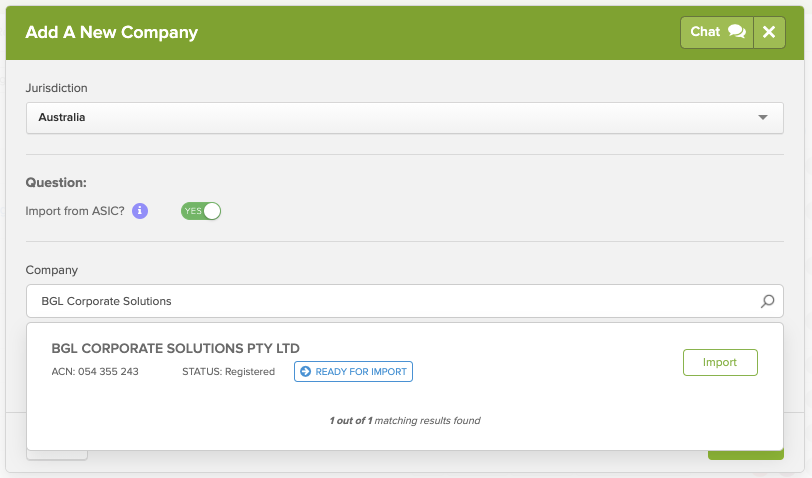
When adding a new company to CAS 360, you can now import the basic company information directly from ASIC.
If you toggle on the ‘Import from ASIC?’ CAS 360 will conduct a real time search of the ASIC register and find the company for you.
Clicking on import, will add the company to your CAS 360 company list, and also import the basic company information (Company Name, Number, Company type and class).
CAS 360 is the best place to manage all of the trusts that your firm looks after, with industry leading trust features.
In this update, we add more documentation for trusts.
When preparing unitholder transactions, if there is an allotment transaction, CAS 360 will now prepare a unit allotment journal, and for unit transfers CA360 will now prepare a unit transfer journal.
New Trust registers have also been added, with a new Register of Trust Relationships, which will show all of the position holders in the trust. Also, a new Register of Trust Events has been added, which will show all event transactions that have taken place inside the trust.
This update sees a huge change in the way contact data is entered into CAS 360. We have added new fields and grouped a number of key data fields.
We have added support for ‘Other Names’ which include ‘Casual Name’ a long time requested feature, soon this casual name will be appearing on documents such as letters.
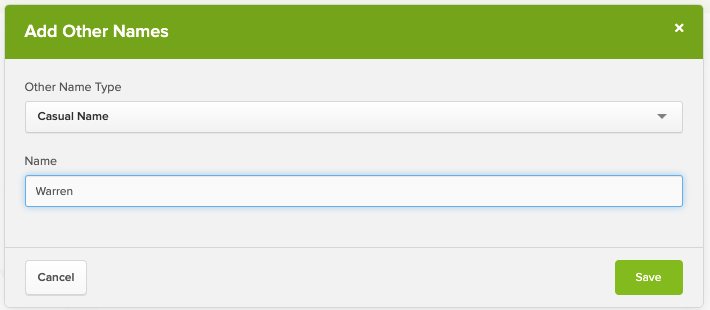
We have also added a whole heap of new contact fields, including identification numbers, and company number types for company contacts.
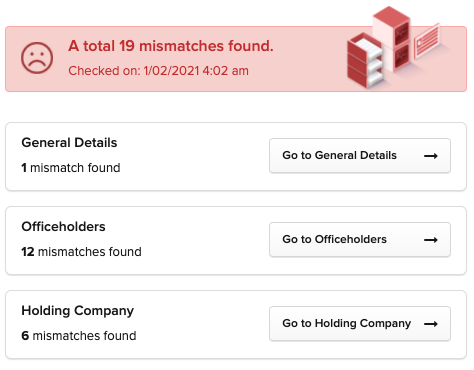
For New Zealand Companies we have expanded the health check to now include General Company Details and Holding company information.
CAS 360 will now check this information every day with the NZ Companies Office and alert you if there have been any changes.
Live Checks (checking when inside the company) has also been added for Company Details and Holding Companies.
If you would like to view the full release notes for February 2021 please click here to visit the BGL Community.
See you next update!
Warren
As a part of the new Treasury Laws Amendment (Combating Illegal Phoenixing) Bill 2020 there will be 2 law changes taking effect on February 18 2021.
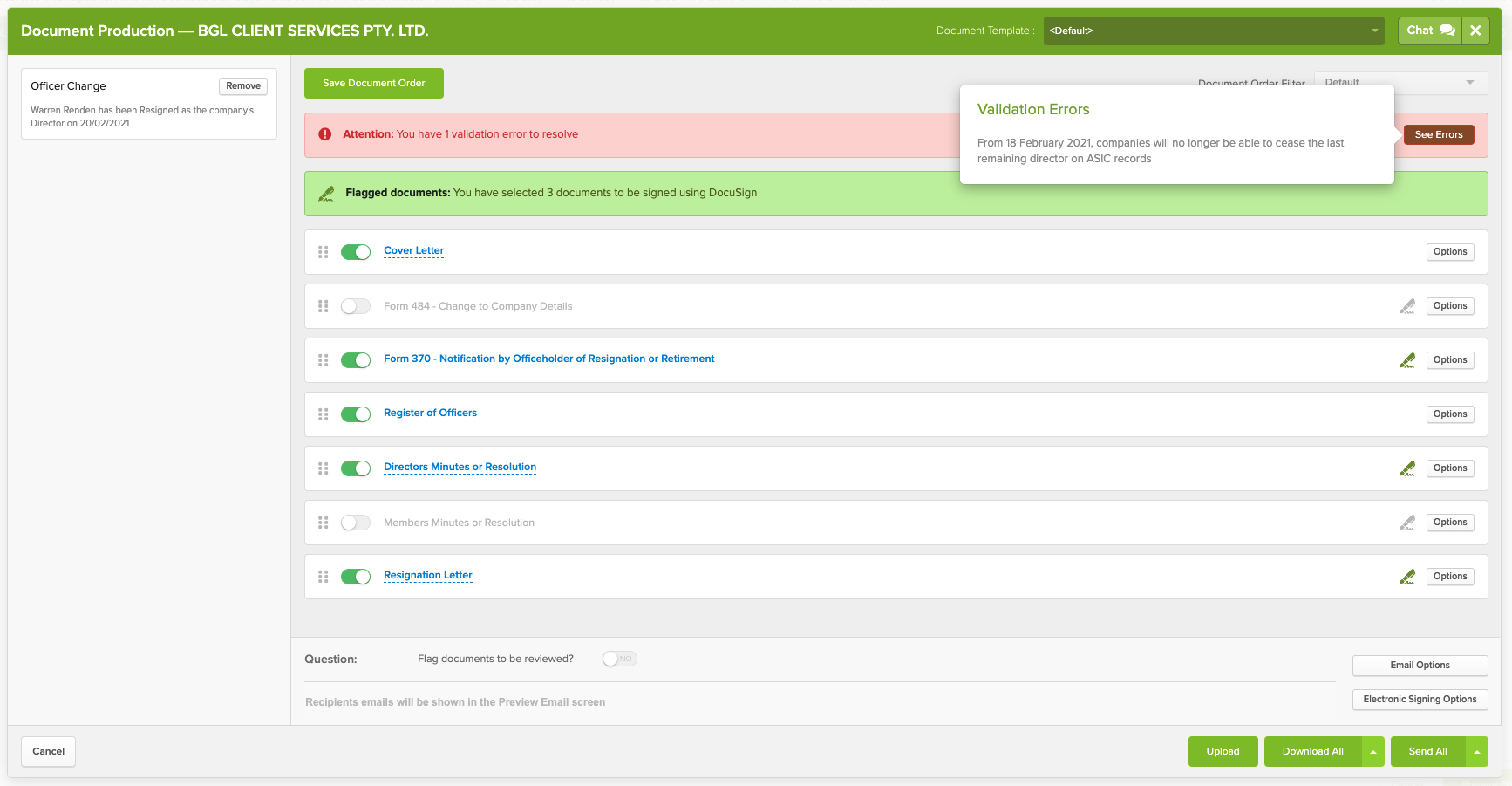
From 18 February 2021, companies will no longer be able to cease the last remaining director on ASIC records.
To enforce this, lodgements submitted using a Form 484 Change to company details, or Form 370 Notification by officeholder of resignation or retirement, to cease the last appointed director without replacing that appointment will be rejected.
There are some exceptions to this, including if:
CAS 360 already had a block on resigning the last remaining director via a form 484, a similar block will be added to the form 370.
We will also add new messaging alerting the users when they are trying to cease the last remaining director.
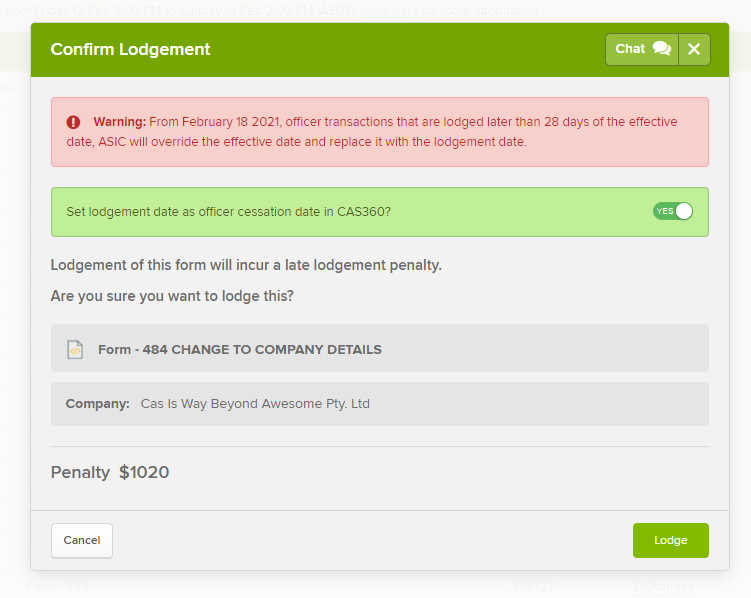
There are significant changes for late lodgements of director cessations.
From February 18 2021, if a director’s cessation date is notified to ASIC more than 28 days after the effective date then the effective date will be overridden and replaced with the lodgement date. Late fees still apply to the Change of company details form in this scenario.
Example
John Smith is a director of ABC Industries Pty Ltd.
John Smith resigns as a director on 1 April 2020; however, the Form 484 is lodged to ASIC on 1 November 2020.
On ASIC’s records, the resignation date will be 1 November 2020. The standard late fees will still apply.
When lodging a document in CAS 360 that is going to receive a late fee.
CAS 360 will always alert you. A new warning will now appear of officer cessation transactions that are later that 28 days to advise the user that the cessation date will be replaced with the lodgement date.

GuestTrack started as an initiative by BGL to help our clients (Accountants) help their clients (Small Businesses) track guests in a COVID-19 environment. As industry leading software developers, GuestTrack was something we released quickly to relieve some stress for our community.
Today, GuestTrack is spectacular market leading guest check-in tool and as we now enter a new normal, we are introducing subscription options so we can recover some of our running costs. These changes come into affect for existing GuestTrack users on Monday 1 February 2021.
All current GuestTrack clients continue to receive a FREE subscription.
| GuestTrack Subscription | Free | Basic | Enterprise | Not-for-profit* |
| Pricing | Free | $9 + GST per month | Contact Us | Free |
| Inclusions | ||||
| Google Ads | ✔️ | ❌ | ❌ | ❌ |
| Unlimited Check-ins/outs | ✔️ | ✔️ | ✔️ | ✔️ |
| Unlimited QR Codes | ✔️ | ✔️ | ✔️ | ✔️ |
| Customisable Form | ✔️ | ✔️ | ✔️ | ✔️ |
| 56 Day Data Retention | ✔️ | ✔️ | ✔️ | ✔️ |
| Email & SMS Notifications | ❌ | ❌ | ✔️ | ❌ |
| Phone, ID & Face Verification | ❌ | ❌ | ✔️ | ❌ |
| CRM, Booking & API Integration | ❌ | ❌ | ✔️ | ❌ |
| AI Analysis & Data Prediction | ❌ | ❌ | ✔️ | ❌ |
* To be eligible for the Not-for-profit GuestTrack Subscription, you must satisfy one of the following requirements: (1) Your registered email ends with .gov.au (2) Your organisation is listed on the ACNC.
Reminder: BGL cannot sell, share or profit from any of the personal data collected by GuestTrack as it is encrypted, and we simply do not have access to it. The data is owned by the GuestTrack account owner (business using GuestTrack) and no one else can decrypt or access this data. GuestTrack Terms and Conditions | Privacy Policy

This has been a tumultuous year for BGL, our clients and the superannuation industry.
During the year, the government introduced another super early release scheme – this time in response to COVID-19.
I have asked our friends at mProjections to do a couple of calculations to demonstrate the impact of a withdrawal and how to engineer a higher retirement. Please check these out.
Example 1
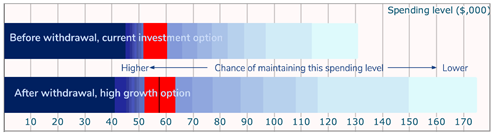
Phillippa, 29, worked in the hospitality industry with 2 jobs, total income (pre Covid) of around $55,000pa, pre-tax. She is single and had built up a Super balance of $25,000.
Shortly after loosing one of those jobs, she withdrew $8,000 without thinking about the consequences to super. Her Super had been invested in a typical ‘Balanced’ Investment Option with 65% in growth assets.
Using the mProjections Report, Philippa moved her post-withdrawal balance to a High Growth Investment Option (85% in growth assets). She saw that, before withdrawal, she would have $55,194 pa annual retirement income for 25 years, but with a move to High-Growth – without additional contributions – she would enjoy a $57,415 projection. Most importantly, her upside for a considerable improvement in retirement spending would increase.
Example 2
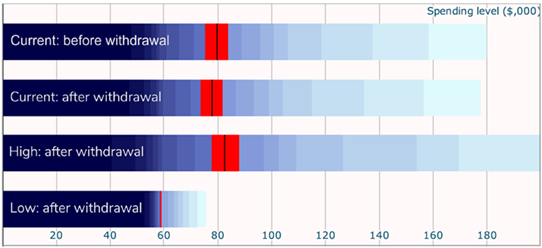
Jonathan works as an electrician in the western suburbs of Sydney and had his hours reduced to 20 hours per week for 3 months. He decided to withdraw $8,500. Using figures in our Report, he saw how to increase his $79,747 tax-free pre-withdrawal retirement projection by moving the balance of his fund to a High Growth Investment Option and a consequent retirement income projection of $82,442.
He also noted the greater likelihood of upside. ‘Low’ here is 15% of assets in growth.
If you would like to prepare an mProjections report for your clients, check out their website.

We are nearly at the end of 2020, and what a year it has been. It is certainly not a year I want to remember and the sooner we get (in my opinion) to 2021 the better.
BGL has a lot to be thankful for this year. Your support of my team and I has been fantastic and we all really appreciate it.
Working from home, Zoom meetings, doom and gloom from our media, has made our lives difficult. The winding back of restrictions, especially in Victoria, is well overdue.
We decided to close the BGL office for 3 weeks from 21 December 2020 to 8 January 2021 (inclusive). My team needs this time to refresh and recover from what has been a tough year. Very few have had any time off during the year.
I am looking forward to 2021 and the gradual opening up of Australian business. I feel very sad for so many small businesses that are not able to reopen. As a small business owner, my heart goes out to each and every one of them.
For BGL, 2021 will be very exciting. With the release of our 3rd cloud product Simple Invest 360 and some amazing developments coming from our product teams, 2021 will provide a heap of opportunities for clients and our Team.
I would like to sincerely thank the BGL Team that has grown to over 170 through 2020. The work you do and the service you provide our clients is invaluable.
Last, I would like to thank each and every one of YOU for being BGL clients in 2020. I hope we have lived up to your expectations.
Please have a safe and happy festive season and a prosperous 2021!

Welcome our new blog series, which explores some new apps & existing app updates on the BGL block!

“It’s great to see a proper analysis of SMSF cost and return data” said BGL’s Managing Director, Ron Lesh. “And knowing the vast majority of the data came from BGL’s Simple Fund 360 clients makes me even more proud.”
“The report shows the cost of running an SMSF highlighting that larger balance SMSFs cost less to operate than any other type of superannuation fund or account” noted Lesh. “And for smaller balances, SMSFs are comparable with APRA regulated funds”
The report data was sourced from BGL’s Simple Fund 360 and Super Concepts SuperMate software. “It is great to see 2 industry software companies working with Rice Warner to provide the data required to prepare the report at no cost to the SMSFA” added Lesh. “It is unfortunate that not all industry software companies chose to participate”.
“The other data I also found fascinating was the table on Page 21 of the Report showing investment returns for the last 14 years “says Lesh. “From 2005 to 2018, for 9 of the 14 years returns shown in the table, SMSFs performed better than APRA regulated funds”
“Clearly this shows ASIC’s SMSFs are not for everyone flyer was absolute rubbish” stated Lesh. “I said this flyer was misleading and did not fairly represent the cost of running an SMSF. The Rice Warner report validates my statements and furthermore shows that SMSFs with a balance of less than $500,000 are clearly cost competitive with APRA funds dispelling statements made in the December 2018 Productivity Commission report”

There has been a lot written about Australia’s response to the COVID-19 virus. You have many cheering on the lockdowns and restrictions most of whom were largely unaffected. Politicians, public servants and most of the media were very lucky to escape the economic consequences of COVID-19.
But as most of our clients know, their clients were not. Many thousands of businesses will never return.
Many people, especially the young, will find it difficult to find a job for a long time.
Some businesses were lucky – they were able to not only survive but thrive during COVID-19. I am lucky BGL was one of those businesses.
But the question I keep asking is did we overreact ? And don’t think I am being heartless. I said all along we need to protect the vulnerable – a job which was done extremely poorly by the Victorian state government. But we also needed to better handle testing and maybe we should have put ANYONE who had the virus in proper quarantine. rather than letting them stay at home and go out for exercise!
We still have no idea of the long term mental health consequences of the lockdowns. I see it in my people. I see many suffering from a lack of social contact. Those that have regularly come into the office through the lockdown appear to be in a better mental state than those who did not. I worry about the long term effects and wonder what it would have been like if the virus was handled this differently.
I look at countries like Japan, Taiwan and Vietnam who did a great job of managing COVID-19. They did not do it with lockdowns. They did not lecture or scare their communities – they brought their communities along for the ride. Unfortunately our governments did not take this approach.
So what would have happened if our governments had not imposed draconian lockdowns on our communities ? The answer is we don’t know. The Andrews government imposed masks in Victoria, for example, but gave no time to see if this alone reduced the spread of the virus. In other words, in the name of keeping us safe, our governments and their group of poorly qualified Chief Health Officers decided on what was easiest for them.
I don’t know the answer – but either do they.
What I do know is unemployment is only being kept low by Jobkeeper and that our governments have generated a huge amount of intergenerational debt that our children will have to repay. I wonder if they really understand this. Few of our politicians were around when interest rates were 20%
We certainly are not all in this together.
Those who imposed the rules are all fine. Most did not lose 1 cent of income – in fact many even got a salary increase during COVID-19 while their lockdowns put so many people out of work. Those on whom the rules were imposed are not fine.
I always question when a government says we are doing this to keep you safe. Because keeping us safe always seems to lead to a loss of our rights and freedoms.
I have had huge concerns about the mental health of my team during the lockdowns in Victoria. The Victorian government seem to have ignored mental health. They are so focussed on eliminating COVID-19 they forgot all else. More is being written about the mental health affects of the lockdown now. I recently came across this article Victoria fights back COVID-19, but at what cost?
All the more reason you need the CAS 360 and Simple Fund 360 Top 50 features list when comparing software providers.

© 2026 BGL Corporate Solutions Pty Ltd.
Recent Comments